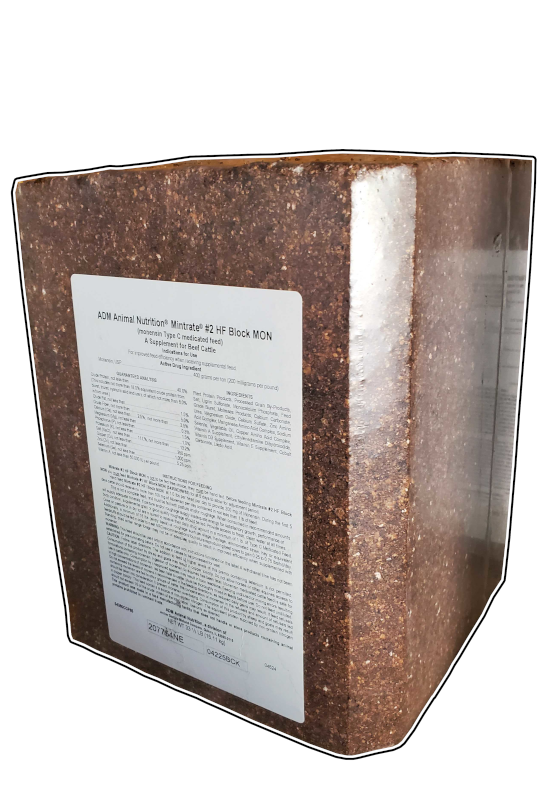
For improved feed efficiency when receiving supplemental feed.
Tag Information
Active Drug Ingredient
| Monensin, USP | 400 grams per ton (200 milligrams per pound) |
Guaranteed Analysis
| Crude Protein, not less than (This includes not more than 18.0% equivalent crude protein from biuret, triuret, cyanuric acid, and urea, of which not more than 8.0% is from urea.) | 40% |
| Crude Fat, not less than | 1.5% |
| Crude Fiber, not more than | 5.0% |
| Calcium (Ca), not less than 2.5% not more than | 3.5% |
| Magnesium (Mg), not less than | 0.3% |
| Phosphorus (P), not less than | 1.5% |
| Potassium (K), Not less than | 1.0% |
| Salt (NaCl), not less than 11.0% not more than | 13.2% |
| Copper (Cu), not less than | 250 ppm |
| Zinc (Zn), not less than | 1,000 ppm |
| Selenium (Se) not less than | 5.25 ppm |
| Vitamin A, not less than 50,000 IU per pound |
Ingredients
Plant Protein Products, Processed Grain By-Products, Salt, Lignin Sulfonate, Monocalcium Phosphate, Feed Grade Biuret, Molasses Products, Calcium Carbonate, Urea, Magnesium Oxide, Calcium Sulfate, Zinc Amino Acid Complex, Manganese Amino Acid Complex, Sodium Selenite, Vegetable Oil, Copper Amino Acid Complex, Vitamin A Supplement, Vitamin D3 Supplement, Vitamin E Supplement, Ethylenediamine Dihydroiodide, Cobalt Carbonate, Lactic Acid.
INSTRUCTIONS FOR FEEDING
Mintrate #2 HF Block MON is not to be fed free choice, they must be hand fed. Before feeding Mintrate #2 HF Block MON you must feed Mintrate #1 HF Block MON (54359CBW65) for at 5 days to allow for adjustment period. Hand feed Mintrate #2 HF Block MON at 1.0 lbs per head per day to provide 200 mg of Monensin. During the first 5 days cattle should receive no more than 100 mg of Monensin per day contained in not less than 1 lb of feed. This is not a complete feed, and must be fed with pasture and/or roughage. When consumed in recommended amounts will supply adequate minerals. If pasture and/or roughage supply inadequate energy for satisfactory growth, performance or body condition, supplemental grain or good quality roughage should be fed. Provide access to fresh, clean water at all times. Cows on pasture or in dry lot are required to receive their daily drug amount in a minimum of 1 lb. of Type C Medicated Feed. Additionally, a minimum of 16 Ibs (airdry basis) of roughage such as silage, haylage, ammoniated straw, hay or equivalent feedstuffs should be fed in order to meet NRC recommendations for mature reproducing beef cows to gain 0.25 to 0.75 Ibs/hd/day. Standing, dried winter range forage may not be of adequate quality to result in improved efficiency when supplemented with monensin.
WARNING: This feed should be used only in accordance with instructions furnished on the label.A withdrawal time has not been established for pre-ruminating calves. Do not use in calves to be processed for veal.
CAUTION: Follow label directions. The addition to feed of higher levels of this premix containing selenium is not permited. Consumption of this product by sheep and goats may result in copper toxicity. Do not allow horses or other equines access to formulations containing monensin. Ingestion of monensin by equines has been fatal. Monensin medicated cattle feed is safe for use in cattle only. Consumption by unapproved species may result in toxic reactions. Feeding undiluted or mixing errors resulting in high concentrations of monensin has been fatal to cattle. Must be thoroughly mixed in feeds before use. Do not feed undiluted. Do not exceed the levels of monensin recommended in the feeding directions, as reduced daily gains may result. If feed refusals containing monensin are fed to other groups of cattle, the concentration of monensin in the refusals and amount of refusals fed should be taken into consideration to prevent monensin overdosing. Consumption of this product by sheep and goats may result in copper toxicity. This feed contains a source of non-protein nitrogen. The equivalent protein supplied by non-protein nitrogen should not exceed 1/3 of the crude protein of the total ration. Use only as directed. This product was made in a feed manufacturing facility that does not handle or store products containing animal proteins prohibited in ruminant feeds.